Inverters, Meters, Sensors & WMS: Key Components of a Solar Plant
Introduction
Most people think solar plants are just panels and wires.
In reality, a solar plant is a system of many carefully connected components, each one doing a specific job. Remove or neglect any one of them, and the plant either stops working, silently loses generation, or fails compliance checks.
This guide explains every key component inside a solar plant: what it is, what it does, and why it matters in simple, clear language.
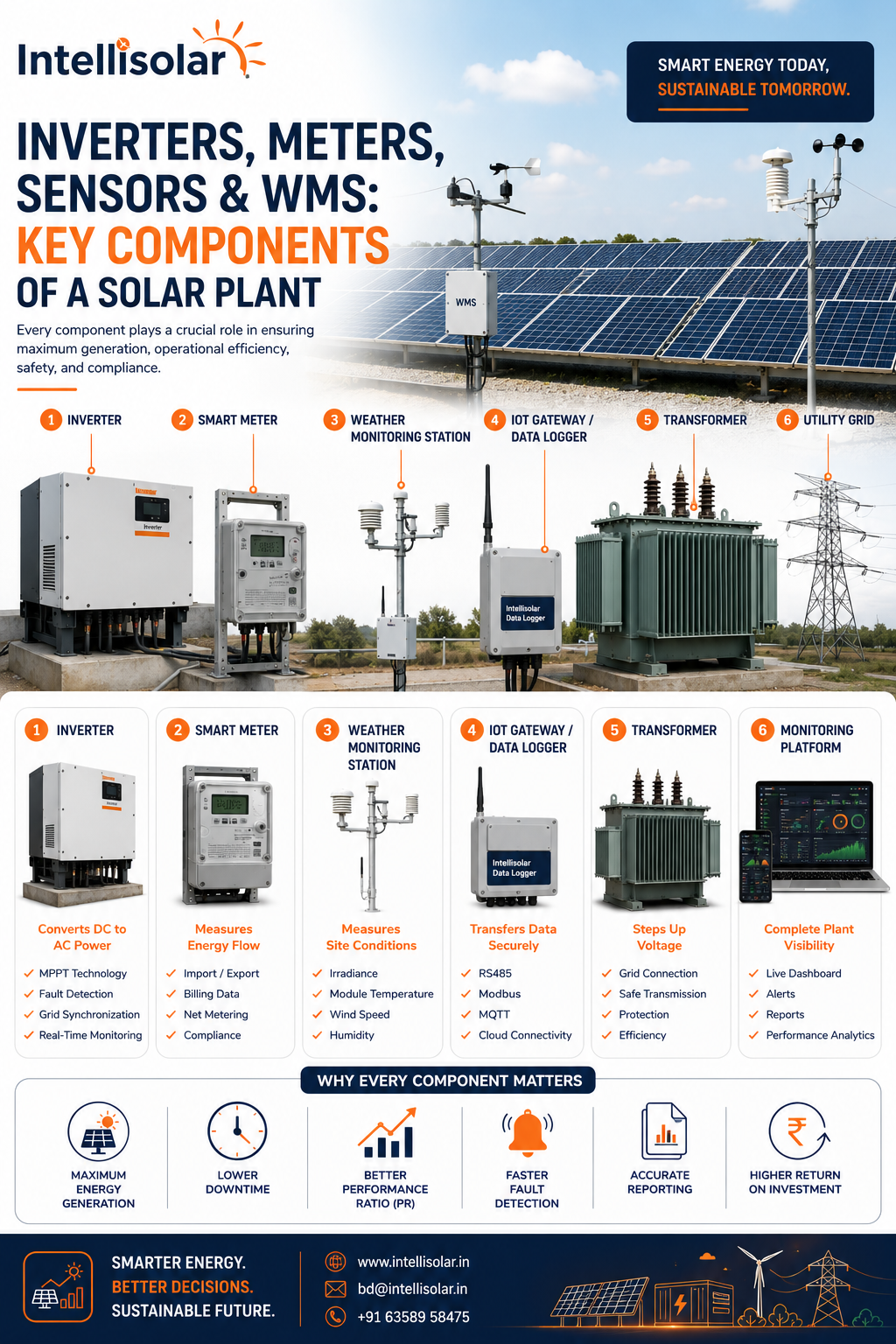
Key Components of a Solar Plant
1. Solar Inverter
The inverter is the single most important piece of equipment in a solar plant after the panels themselves.
What it does:
-
Converts DC to AC: Converts DC (Direct Current) electricity from panels into AC (Alternating Current) electricity used by homes, businesses, and the grid.
-
Runs MPPT (Maximum Power Point Tracking): Continuously extracts maximum possible power from panels at every moment as sunlight and temperature change.
-
Monitors System: Tracks voltage, current, and temperature in real time.
-
Fault Detection: Detects and automatically reports faults at the string or inverter level.
-
Data Transmission: Sends live data to the monitoring platform every minute.
Types of Inverters:
-
String Inverter: One inverter handles a group (string) of panels; common in commercial and utility-scale plants.
-
Microinverter: One small inverter per individual panel; better performance under shading conditions.
-
Hybrid Inverter: Handles both solar generation and battery storage (BESS) in one unit.
Key Takeaway: A failed inverter that goes undetected for 48 hours can cost an MW-scale plant lakhs in lost generation. Modern inverters detect and report faults within minutes.
2. Energy Meters
Meters measure the exact flow of electricity at key points across the plant.
Types of Meters:
-
Generation Meter: Measures total electricity produced by the panels and inverters.
-
Export/Import Meter: Measures electricity sent to the grid and electricity drawn back under net metering.
-
Consumption Meter: Used in hybrid and C&I plants to track on-site usage vs. export.
Why Metering Data Matters:
-
Commercial Settlement: Payment under a PPA or net metering agreement is calculated from meter data.
-
Regulatory Compliance: Feeds into grid codes, zero export rules, and MNRE reporting requirements.
-
Performance Verification: Actual generation compared against expected output.
Traditional vs. Smart Meters
| Feature | Traditional Meter | Smart Meter |
| Data Collection | Read manually once a month | Logs data every 15 minutes automatically |
| Integration | No integration with monitoring | Pushes data directly to SCADA/RMS |
| Dispute Resolution | Billing disputes take weeks | Real-time generation and export visibility |
| Portal Integration | No portal integration | Direct push to MNRE, DISCOM, PM-KUSUM portals |
3. Sensors
Sensors capture the electrical and environmental conditions that determine whether a plant’s output is normal for that moment.
Key Sensors in a Solar Plant:
-
Irradiance Sensor (Pyranometer): Measures how much solar radiation is hitting the panels right now; the most important sensor for performance calculation.
-
Module Temperature Sensor: Panel efficiency drops as temperature rises; this sensor is critical for accurate PR calculation.
-
Ambient Temperature Sensor: Measures surrounding air temperature.
-
Wind Speed & Direction Sensor: Relevant for both performance analysis and structural safety.
-
Soiling Sensor: Measures dust and dirt buildup on panel surfaces; critical in high-dust regions like Gujarat and Rajasthan.
Impact of Soiling: Soiling loss of just 5% across a 10 MW plant can cost over ₹15–20 lakh per year in lost generation. A soiling sensor tells you exactly when to clean without guessing.
4. Weather Monitoring Station (WMS)
A WMS is a complete unit installed at the plant site that houses multiple sensors, including irradiance, temperature, wind, and humidity, in a single integrated system.
What a WMS Captures:
-
Plane-of-Array (POA) Irradiance: Sunlight hitting the panels at their exact angle
-
Global Horizontal Irradiance (GHI): Total sunlight from above
-
Module and Ambient Temperature
-
Wind Speed and Direction
-
Humidity
-
Soiling Index
Why WMS is Not Optional
Without a WMS, you cannot answer the most important question in solar operations: Is the plant underperforming because of a real equipment fault or because it is a cloudy afternoon?
With WMS data, your monitoring platform calculates exactly what the plant should be generating at every moment. Any difference from actual generation triggers a specific, weather-adjusted alarm, not just a raw number drop.
WMS Data Directly Powers:
-
Performance Ratio (PR) calculation
-
Capacity Utilization Factor (CUF) calculation
-
Generation loss analysis
-
Fault detection alarm thresholds
5. Data Logger and IoT Gateway
All the data generated by inverters, meters, and sensors needs to travel from the field to the monitoring platform. This is the job of the data logger and IoT gateway.
How Data Flows:
-
Inverters, meters, and sensors communicate over Modbus RTU/RS485 to the data logger.
-
The data logger aggregates all readings and forwards them through the IoT gateway.
-
The IoT gateway transmits data to the cloud or on-site SCADA server over MQTT or TCP/IP.
-
The monitoring platform receives, stores, and displays the data in real time.
Connectivity Alert: If the IoT gateway fails or loses connectivity, data stops flowing and your monitoring platform goes blind. Modern gateways include cellular 4G backups for exactly this reason.
6. Transformer and Switchgear
Before electricity leaves the plant, it needs to be prepared for grid transmission.
-
Step-up Transformer: Increases AC voltage to match grid transmission requirements; plants above 500 kW typically require this.
-
Switchgear: Handles automatic safety isolation; disconnects faulty sections of the plant instantly to protect both equipment and people.
-
Protection Relays: Monitor grid-side parameters and trigger switchgear when voltage or frequency goes out of range.
How All Components Work Together
Every component in a solar plant is part of one connected system:
-
Panels generate DC electricity.
-
Inverters convert DC to AC and report live data.
-
Meters record generation, export, and import for settlement and compliance.
-
Sensors and WMS provide the environmental baseline that makes every performance metric meaningful.
-
Data Loggers and IoT gateways carry all this data from the field to the platform.
-
Transformers and Switchgear condition power for safe grid connection.
-
The SCADA/RMS platform brings everything together on one screen in real time.
A fault that is invisible when you look at each component in isolation becomes obvious the moment inverter output, meter readings, and WMS data are viewed together on one monitoring platform.
Conclusion
A solar plant’s potential is defined by its panels and inverters. But how much of that potential is actually realized, day after day, year after year, depends entirely on how well these components are connected, monitored, and maintained.
Every component in this list either generates data, moves data, or acts on data. When all of them work together and are connected to a smart monitoring system, a solar plant performs the way it was designed to.
When even one is missing or ignored, generation leaks silently, and no one knows until the monthly report arrives.
Frequently Asked Questions
Which is the most important component of a solar plant besides the panels?
The inverter. It converts power, maximizes generation through MPPT, detects faults automatically, and sends live data to the monitoring system. Everything depends on it working correctly.
My solar plant has an inverter display. Do I still need a separate monitoring system?
Yes. An inverter display only shows data for that one inverter. A monitoring system shows every inverter, every meter, and every sensor together, with alarms, trends, and remote control from anywhere.
What is MPPT, and will it increase my generation?
MPPT (Maximum Power Point Tracking) continuously adjusts the inverter to extract the maximum possible power from your panels at every moment as sunlight and temperature change. Yes, it directly increases generation compared to inverters without proper MPPT.
Why does my solar plant need a weather station? Can’t I just check the weather app?
A weather app gives general area forecasts. A WMS measures the exact irradiance hitting your panels at your specific site right now. These are very different, and only site-specific WMS data can tell you whether your plant is underperforming due to a real fault or reduced sunlight.
My plant has been running for 2 years without a WMS. Is that a problem?
Yes. Without WMS data, your PR and CUF calculations are estimates, not actual measurements. You likely have generation losses you are not aware of and no way to prove performance to investors or comply with MNRE requirements accurately.
What is a soiling sensor, and do I really need one?
A soiling sensor measures how much dust and dirt have built up on your panels. In dusty regions of India, soiling can reduce generation by 5–10% or more. Without a sensor, you either clean too often (wasting money) or not often enough (losing generation).
What happens to my monitoring if the internet goes down at the plant site?
Modern IoT gateways store data locally and have 4G cellular backup. When connectivity is restored, the stored data syncs automatically so no readings are permanently lost.
I have a 100 kW rooftop plant. Do I need all these components?
At 100 kW, you need at minimum an inverter with MPPT, a generation meter, and basic monitoring. A WMS becomes more valuable as plant size increases, but even at 100 kW, irradiance data helps separate cloudy-day dips from real faults.