
Inverters, Meters, Sensors & WMS: Key Components of a Solar Plant

Introduction
Most people think solar plants are just panels and wires.
In reality, a solar plant is a system of many carefully connected components, each one doing a specific job. Remove or neglect any one of them, and the plant either stops working, silently loses generation, or fails compliance checks.
This guide explains every key component inside a solar plant: what it is, what it does, and why it matters in simple, clear language.
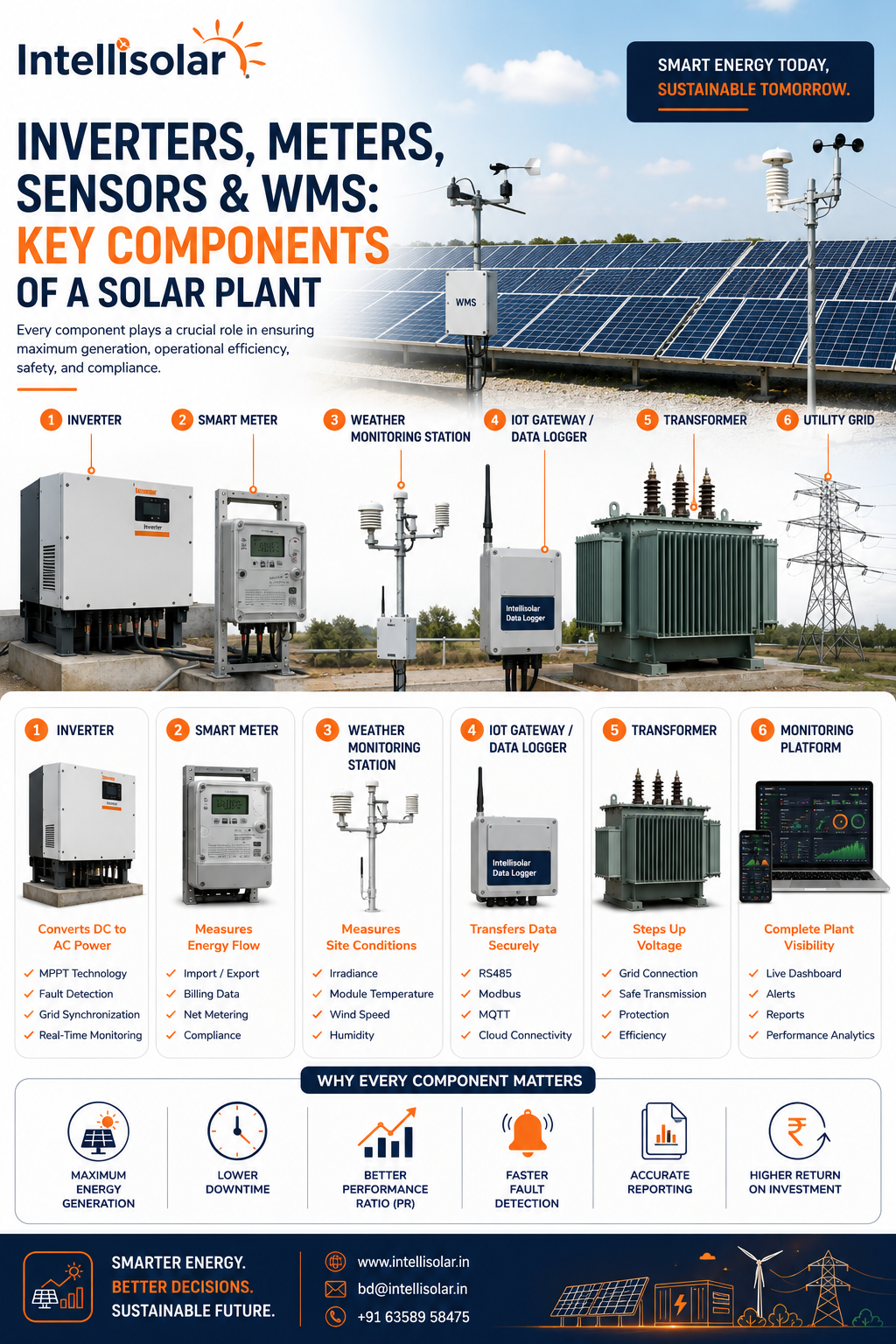
Key Components of a Solar Plant
Solar Inverter
The inverter is the single most important piece of equipment in a solar plant after the panels themselves.
What Does a Solar Inverter Do?
- Converts DC to AC: Converts DC (Direct Current) electricity from panels into AC (Alternating Current) electricity used by homes, businesses, and the grid.
- Runs MPPT (Maximum Power Point Tracking): Continuously extracts maximum possible power from panels as sunlight and temperature change.
- Monitors the System: Tracks voltage, current, and temperature in real time.
- Detects Faults: Detects and automatically reports faults at the string or inverter level.
- Transmits Data: Sends live operational data to the monitoring platform.
Types of Solar Inverters
- String Inverter: One inverter handles a group of panels and is common in commercial and utility-scale plants.
- Microinverter: One small inverter is installed per individual panel, offering advantages in systems with shading or different panel orientations.
- Hybrid Inverter: Handles both solar generation and battery storage (BESS) within the same system.
Key Takeaway: A failed inverter that goes undetected for 48 hours can cost an MW-scale plant significant revenue in lost generation. Modern monitoring systems can detect and report inverter faults within minutes.
Energy Meters
Meters measure the exact flow of electricity at key points across the plant.
Types of Energy Meters
- Generation Meter: Measures total electricity produced by the panels and inverters.
- Export/Import Meter: Measures electricity sent to the grid and electricity drawn from the grid under applicable net metering arrangements.
- Consumption Meter: Used in hybrid and C&I plants to track on-site consumption versus exported energy.
Why Metering Data Matters
- Commercial Settlement: Payment under a PPA or applicable net metering agreement is calculated from meter data.
- Regulatory Compliance: Metering data supports grid codes, zero-export requirements, and applicable reporting requirements.
- Performance Verification: Actual generation can be compared against expected output.
Traditional vs. Smart Meters
FeatureTraditional MeterSmart MeterData CollectionRead manually once a monthLogs data automatically at defined intervalsIntegrationLimited or no monitoring integrationCan push data directly to SCADA/RMSDispute ResolutionBilling and generation disputes can take longer to resolveReal-time generation and export visibilityPortal IntegrationLimited integrationCan support automated data exchange with applicable portals
Sensors
Sensors capture the electrical and environmental conditions that determine whether a plant’s output is normal for that moment.
Key Sensors in a Solar Plant
- Irradiance Sensor (Pyranometer): Measures how much solar radiation is reaching the panels and is essential for performance calculations.
- Module Temperature Sensor: Measures panel temperature, which affects solar module efficiency and performance calculations.
- Ambient Temperature Sensor: Measures the surrounding air temperature.
- Wind Speed and Direction Sensor: Provides information useful for performance analysis and structural safety.
- Soiling Sensor: Measures dust and dirt buildup on panel surfaces, which can be particularly important in high-dust regions.
Impact of Soiling: Even a small percentage of soiling loss across a large solar plant can translate into significant annual generation losses. A soiling sensor helps operators determine when cleaning is actually required instead of relying on guesswork.
Weather Monitoring Station (WMS)
A Weather Monitoring Station (WMS) is an integrated system installed at the plant site that houses multiple sensors, including irradiance, temperature, wind, and humidity sensors.
What Does a WMS Capture?
- Plane-of-Array (POA) Irradiance: Measures sunlight reaching the panels at their installed angle.
- Global Horizontal Irradiance (GHI): Measures total solar radiation received on a horizontal surface.
- Module and Ambient Temperature: Tracks panel and surrounding air temperatures.
- Wind Speed and Direction: Tracks local wind conditions.
- Humidity: Measures atmospheric moisture levels.
- Soiling Index: Helps quantify the impact of dust accumulation on panel performance.
Why Is WMS Important?
Without a WMS, it becomes difficult to answer one of the most important questions in solar operations: Is the plant underperforming because of an equipment fault or because of reduced sunlight?
With WMS data, a monitoring platform can establish an expected production baseline for current weather conditions. Differences between expected and actual generation can then be investigated more accurately.
What Does WMS Data Help Calculate?
- Performance Ratio (PR)
- Capacity Utilization Factor (CUF)
- Generation loss analysis
- Weather-adjusted fault detection and alarm thresholds
Data Logger and IoT Gateway
All the data generated by inverters, meters, and sensors needs to travel from the field to the monitoring platform. This is the job of the data logger and IoT gateway.
How Does Data Flow?
- Inverters, meters, and sensors communicate over protocols such as Modbus RTU and RS485 with the data logger.
- The data logger aggregates the readings and forwards them through the IoT gateway.
- The IoT gateway transmits data to the cloud or on-site SCADA server using technologies such as MQTT or TCP/IP.
- The monitoring platform receives, stores, processes, and displays the data in real time.
Connectivity Alert: If the IoT gateway fails or loses connectivity, data flow can stop and the monitoring platform can lose visibility. Modern gateways can include cellular connectivity and backup communication options to improve data availability.
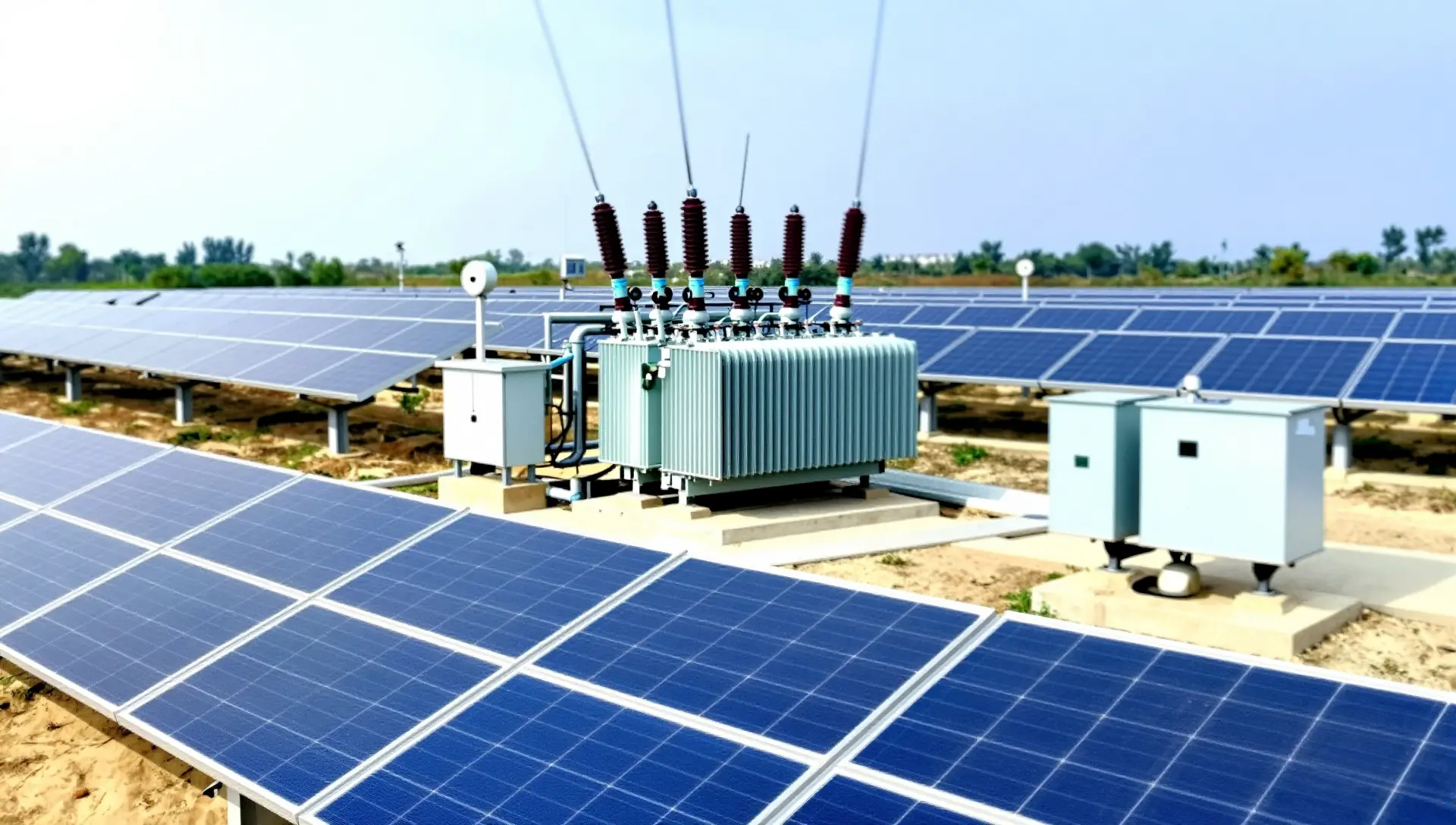
Transformer and Switchgear
Before electricity leaves the plant, it needs to be prepared for safe grid transmission.
Step-Up Transformer
A step-up transformer increases AC voltage to the level required for grid transmission, reducing losses during power transfer.
Switchgear
Switchgear provides electrical isolation and protection by disconnecting faulty sections of the plant when abnormal conditions occur.
Protection Relays
Protection relays monitor grid-side electrical parameters and can trigger switchgear when conditions such as voltage or frequency move outside defined limits.
How All Components Work Together
Every component in a solar plant is part of one connected system:
- Panels generate DC electricity.
- Inverters convert DC to AC and report live operational data.
- Meters record generation, export, and import for settlement and performance verification.
- Sensors and WMS provide the environmental baseline that makes performance metrics meaningful.
- Data loggers and IoT gateways carry field data to the monitoring platform.
- Transformers and switchgear condition and protect the electrical power for safe grid connection.
- The SCADA/RMS platform brings the data together into a centralized view for real-time monitoring and analysis.
A fault that may be difficult to identify when looking at individual components can become obvious when inverter output, meter readings, and WMS data are analyzed together on one monitoring platform.
Conclusion
A solar plant’s potential is defined by its panels and inverters. But how much of that potential is actually realized, day after day and year after year, depends on how well these components are connected, monitored, and maintained.
Every component in this list either generates data, moves data, or acts on data. When all of them work together and are connected to a smart monitoring system, a solar plant can perform closer to its designed potential.
When even one component is missing or ignored, generation losses can accumulate silently, sometimes becoming visible only when the monthly report arrives.
Frequently Asked Questions
Ready to
Make Your Solar Plant Smarter?
Get a free demo of Intellisolar’s Edge-Enabled IoT SCADA System and experience next-generation solar monitoring.