
PM Surya Sarovar Yojana: How India Plans to Turn Its Reservoirs Into Solar Power Plants

Introduction
For years, one of the biggest hurdles to scaling up solar power in India hasn’t been sunlight—it’s been land. Large solar parks need vast, flat, unshaded stretches of land, and in a densely populated country, that land is increasingly hard to find.
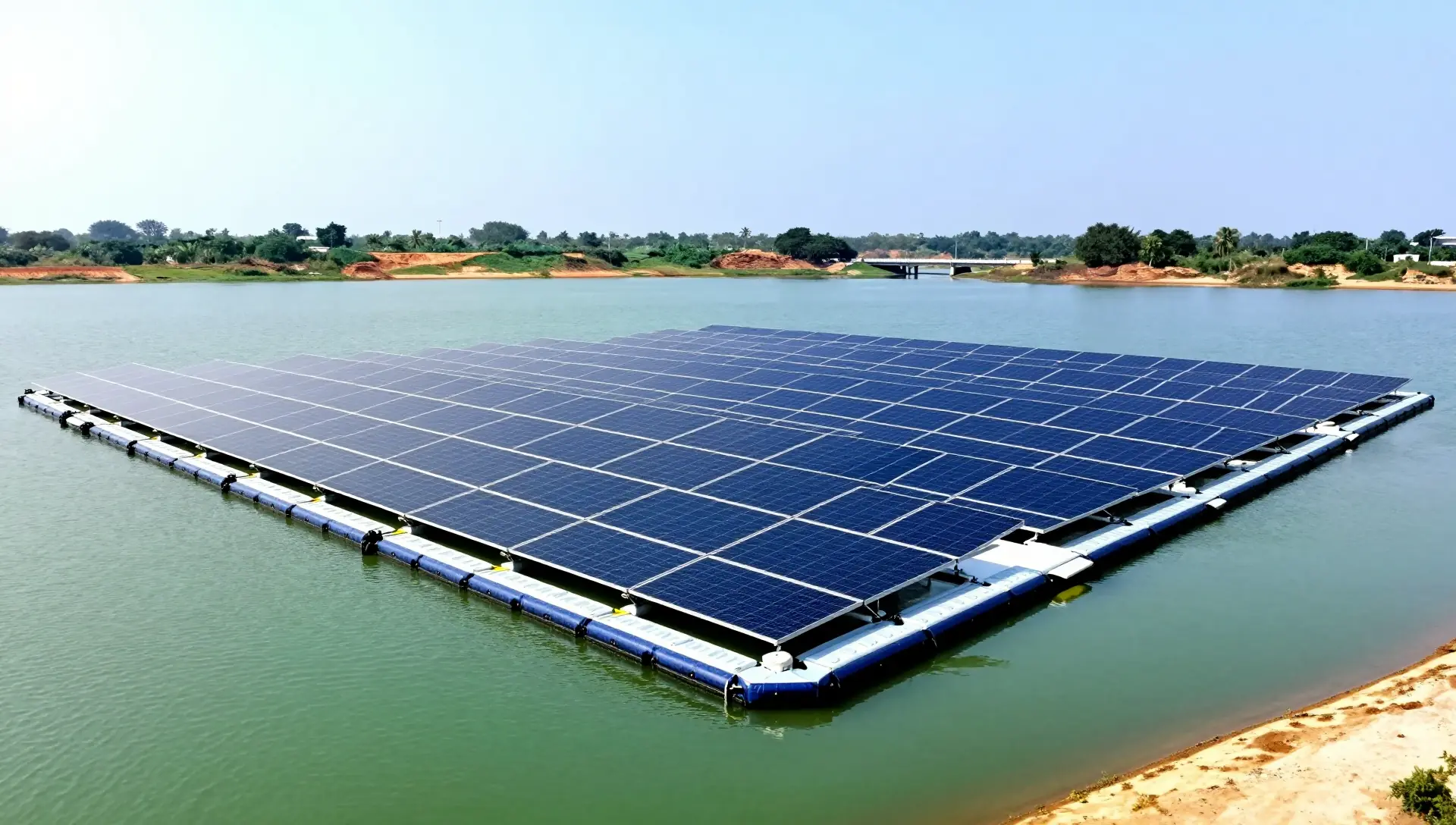
The Pradhan Mantri Surya Sarovar Yojana (PM-SSY), approved by the Union Cabinet on 31 July 2026, takes a different approach entirely. Instead of competing for land, it puts solar panels on water: on reservoirs, dams, lakes, and other inland water bodies across the country.
It’s one of India’s innovative renewable energy schemes, designed to work alongside the country’s other major solar programmes.
Here’s everything you need to know about it.
What Exactly Is PM Surya Sarovar Yojana?
PM-SSY is a Central Sector Scheme run by the Ministry of New and Renewable Energy (MNRE), focused on Floating Solar Photovoltaic (FSPV) projects paired with Energy Storage Systems (ESS).
In simple terms, solar panels are mounted on buoyant platforms that float on the surface of water bodies, generating electricity without occupying land. The power is then stored using co-located battery systems, making the electricity supply more stable and reliable.
PM Surya Sarovar Yojana at a Glance
ParameterDetailFull NamePradhan Mantri Surya Sarovar Yojana (PM-SSY)Approved ByUnion Cabinet, chaired by Prime Minister Narendra ModiApproval Date31 July 2026Scheme TypeCentral Sector SchemeTotal Outlay₹5,070 croreTarget Capacity5,000 MW floating solar + 10,000 MWh battery storageImplementation WindowFY 2026-27 to FY 2030-31Funding Continues TillFY 2032-33Central Financial Assistance₹1 crore per MW, paid after commissioningFeasibility Study SupportUp to ₹50 lakh per study
Why Floating Solar? Why Now?
India Is Running Out of Easy Land for Solar Parks
Ground-mounted solar installations require large, contiguous plots, often competing with agriculture, forests, or urban expansion.
Water bodies, on the other hand, provide relatively underused surface area that can support solar generation without requiring large areas of land.
Water and Solar Panels Are a Surprisingly Good Match
Floating solar isn’t just about saving land. It also comes with several potential technical and environmental advantages.
Natural Cooling Effect
Panels tend to operate more efficiently when their temperatures are moderated by the water beneath them, particularly during hot conditions.
Reduced Water Evaporation
Covering part of a reservoir’s surface with floating solar panels can reduce direct exposure to sunlight and therefore reduce water loss through evaporation.
No Competition With Agriculture or Forestry
Unlike land-based solar projects, floating installations can generate electricity without directly occupying farmland or large areas of natural land.
The Potential Is Enormous and Barely Tapped
According to an assessment by the National Institute of Solar Energy (NISE), India’s floating solar potential across reservoirs and water bodies stands at roughly 102 GWp.
At the time of the scheme’s approval, the country had installed only around 700 MW of floating solar capacity, representing a small fraction of the estimated potential.
PM-SSY is designed to help close that gap.
The Numbers Behind the Scheme
₹5,070 Crore Total Financial Outlay
The scheme has a total financial outlay of ₹5,070 crore.
5,000 MW of Floating Solar Capacity
PM-SSY targets 5,000 MW, or 5 GW, of new floating solar capacity.
10,000 MWh of Battery Storage
The scheme also targets 10,000 MWh of co-located battery storage, with a minimum storage duration of two hours.
₹1 Crore Central Financial Assistance Per MW
Central Financial Assistance of ₹1 crore per MW is provided for successfully commissioned generating capacity.
Up to ₹50 Lakh for Feasibility Studies
Up to ₹50 lakh per project can be provided to support feasibility studies before construction begins.
Projects will be sanctioned in phases between FY 2026-27 and FY 2030-31, with financial disbursement continuing through FY 2032-33. This gives developers a longer runway to plan, construct, and commission projects across different states.
What India Gets Out of PM-SSY
5,000 MW of New Clean Power
The scheme aims to add 5,000 MW of floating solar capacity without requiring equivalent new land acquisition for ground-mounted solar.
Lower Carbon Emissions
Once fully implemented, the scheme is expected to contribute significantly to reducing carbon emissions through additional renewable electricity generation.
New Employment Opportunities
The programme is expected to create jobs across manufacturing, project installation, engineering, operations, and long-term maintenance.
Boost to Domestic Manufacturing
PM-SSY can support domestic manufacturing of floating solar and energy storage components, aligning with India's broader push toward self-reliant renewable energy infrastructure.
Improved Grid Stability
The integrated battery storage component can help make solar power more flexible and useful beyond periods of direct sunlight.
Nationwide Applicability
The scheme is designed to benefit states and Union Territories across India rather than being restricted to regions with large available land banks.
How PM-SSY Fits Into India’s Bigger Solar Picture
PM-SSY does not stand alone. It is one part of a broader renewable energy strategy covering different types of solar deployment and energy storage.
PM Surya Ghar: Muft Bijli Yojana
PM Surya Ghar focuses on rooftop solar for individual households, helping residential consumers generate their own electricity and reduce electricity bills.
It is a separate scheme from PM-SSY, despite the similarity in their names.
PM-KUSUM
PM-KUSUM supports solar-powered agricultural applications, including solar pumps and decentralized solar generation for farmers.
BESS Viability Gap Funding Scheme
The Battery Energy Storage System (BESS) Viability Gap Funding scheme supports large-scale battery storage deployment across India.
International Solar Alliance
The International Solar Alliance (ISA) provides an international platform for promoting solar energy adoption among solar-rich countries.
Together, these programmes address different parts of the renewable energy ecosystem: rooftops, agricultural applications, water bodies, utility-scale generation, and grid-scale storage.
What’s Next for PM Surya Sarovar Yojana?
Because PM-SSY was approved recently, detailed implementation guidelines, state-wise project allocations, and developer or vendor empanelment processes are expected to be released by MNRE.
Developers, utilities, and other stakeholders interested in floating solar projects should follow official MNRE notifications and guidelines as implementation details become available.
Frequently Asked Questions

Ready to
Make Your Solar Plant Smarter?
Get a free demo of Intellisolar’s Edge-Enabled IoT SCADA System and experience next-generation solar monitoring.